

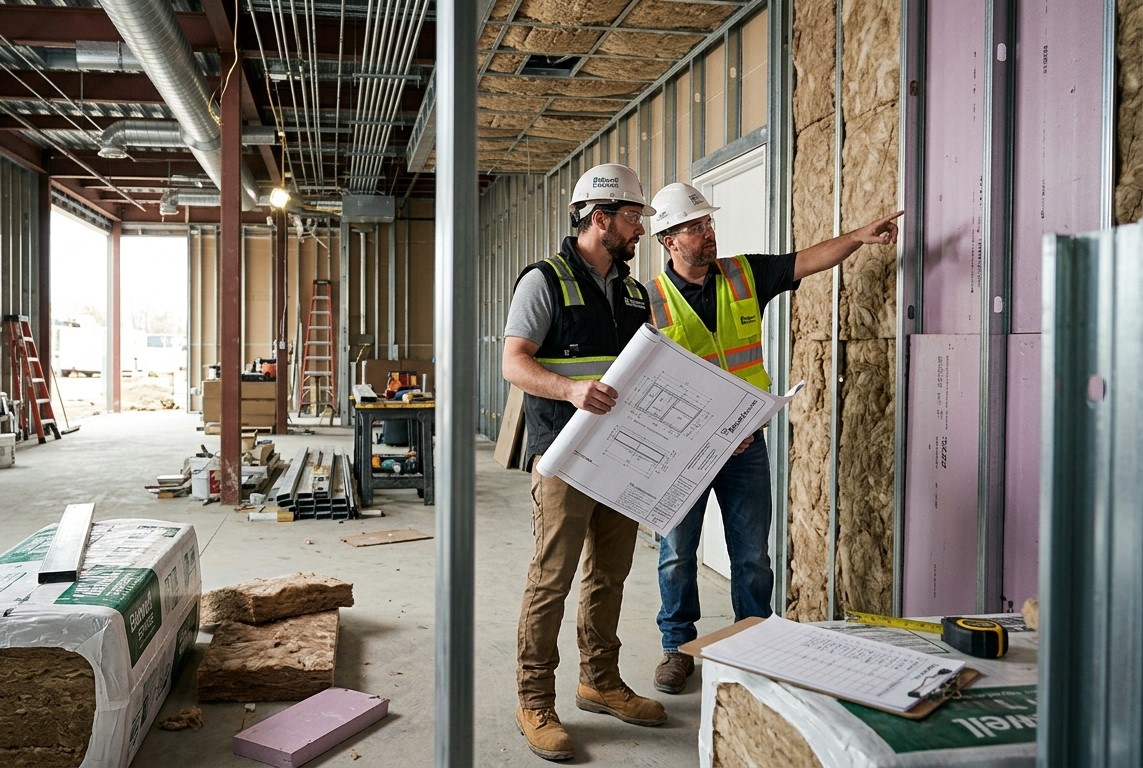
For insulation contractors, general contractors, builders, and construction companies, accurate estimating is more than a preconstruction task. It directly affects profitability, bid competitiveness, project planning, labor allocation, and cash flow.
That is why Insulation Estimating Services can deliver a measurable return on investment. A professional estimate helps contractors understand exactly what a project requires before materials are ordered or crews are scheduled. It can also reduce the costly consequences of missed quantities, incorrect measurements, overlooked areas, and unrealistic labor assumptions.
The real value is not simply receiving a quantity takeoff. It is gaining better information before making a financial commitment.
Inside the Process of Insulation Estimating Services
Insulation Estimating Services involve the detailed measurement, quantity takeoff, material identification, labor assessment, and cost calculation required to prepare an insulation project estimate.
Depending on the project, an estimator may review architectural plans, wall sections, roof assemblies, specifications, schedules, details, and other construction documents to determine requirements for materials such as fiberglass, mineral wool, spray foam, rigid insulation, batt insulation, blown-in insulation, and related products.
A professional estimate can typically help answer questions such as:
- How much insulation material is required?
- Which insulation types and specifications apply?
- How many square feet or linear feet need to be covered?
- What labor quantities should be considered?
- What accessories and related materials are required?
- Where are the potential scope gaps?
- What should be included in the bid?
- Where could material waste or over-ordering occur?
The goal is a transparent, traceable estimate that contractors can review and use for real bidding decisions.
Why Accurate Insulation Estimating Directly Impacts ROI
Profit can disappear through small estimating errors. If a contractor underestimates insulation quantities, they may win a project with an attractive bid but later face unexpected material and labor costs. This can reduce margins, create disputes, cause schedule pressure, or even turn a profitable job into a loss. On the other hand, overestimating quantities can make a bid unnecessarily expensive and reduce the chances of winning the project.
Professional Insulation Estimating Services help contractors price the actual project scope instead of relying on rough assumptions. By improving quantity accuracy and cost visibility, professional estimating can help reduce waste, support competitive bids, save estimating time, and protect expected profit margins. This creates ROI in several practical ways:
Better bid accuracy: More reliable quantities support more defensible pricing.
Reduced material waste: Contractors can purchase closer to the actual project requirements.
Lower administrative burden: Estimators and project managers spend less time manually measuring plans.
Faster bid preparation: Professional takeoffs can help contractors respond to opportunities within tighter deadlines.
Improved profitability: Better cost visibility helps contractors protect their expected margins.
How Insulation Estimating Services Help Contractors Win More Work
Winning a project is not simply about submitting the lowest number. Contractors need a bid that is competitive while still covering the actual cost of delivering the work.
A detailed insulation takeoff can reveal the difference between an aggressive bid and an underpriced bid.
For example, imagine an insulation subcontractor receives a set of commercial drawings containing multiple wall assemblies, ceiling areas, and different insulation specifications. A quick visual estimate might treat all wall areas similarly. A detailed review, however, could identify different insulation requirements by assembly.
That distinction matters.
A professional estimator can organize quantities by area, assembly, material type, or other relevant categories. The contractor can then apply material pricing, labor rates, waste factors, equipment, overhead, and desired profit more confidently.
This makes the bid easier to review and defend.
The Hidden Cost of Doing Every Takeoff In-House
In-house estimating works well for companies with dedicated teams, but smaller contractors often juggle multiple bids, revisions, project questions, and other tasks. Spending hours measuring plans can take time away from client communication, follow-ups, and business development.
Outsourcing estimating can give contractors extra capacity without immediately hiring additional staff. It is especially valuable during busy bidding periods when several projects need to be reviewed and priced at once, helping teams stay focused and meet tight bid deadlines.
What a Professional Insulation Estimate Should Include
Quality matters just as much as speed.
A useful insulation estimate should provide enough information for a contractor to understand where the quantities came from and how they should be applied.
Depending on the project’s requirements, a professional deliverable may include:
- Detailed material quantities
- Area or location breakdowns
- Insulation type and specification references
- Labor considerations
- Waste allowances where appropriate
- Assembly-specific quantities
- Plan or drawing references
- Clarifications and exclusions
- Assumptions requiring contractor confirmation
- Organized takeoff summaries
Transparency is important because contractors should be able to review an estimate rather than simply accept an unexplained final number.
For technical insulation requirements, contractors should also verify applicable project specifications, local requirements, manufacturer documentation, and governing building codes.
The U.S. Department of Energy notes that insulation performance is connected to its R-value and that properly selected and installed insulation can improve comfort and energy efficiency.
Practical Example: Turning a Takeoff Into Better Profit Control
Suppose a contractor is evaluating a multi-unit construction project. The drawings contain several insulation applications, including exterior walls, interior partitions, attic areas, and other assemblies. Instead of applying one blanket allowance to the entire project, the estimator separates quantities according to the documented scope.
The contractor can then compare:
Material quantity + expected waste + labor + equipment + overhead + desired profit = bid price
This approach helps identify unusual quantities before bidding and makes it easier to update estimates when drawings change. It also reduces rework and keeps pricing aligned with the latest project scope. The real ROI comes from better decisions, not just the takeoff itself.
Connecting Insulation Estimating With the Rest of Your Construction Workflow
Insulation is rarely an isolated part of a construction project. It interacts with other trades, assemblies, schedules, and project documents.
For contractors who need broader preconstruction support, Construction Takeoff Services can help organize quantities across multiple divisions and trades, giving project teams a more complete view of the work.
For projects where the bigger challenge is determining the total financial requirement, Construction Cost Estimating can provide broader cost analysis beyond insulation quantities.
Likewise, Flooring Estimating Services can support accurate flooring material and labor calculations when the project includes substantial finish work.
Keeping these estimating functions coordinated can reduce gaps between individual trade estimates and the overall project budget.
Why Contractors Should Treat Estimating as a Business Investment
The cheapest estimating process is not necessarily the most economical.
A contractor could spend less money by using rough measurements, generic allowances, or rushed manual calculations. But if that approach causes one significant bidding mistake, the apparent savings can quickly disappear.
A better question is:
How much does accurate estimating protect or create in potential project profit?
If professional estimating helps a contractor avoid one major scope omission, improve several competitive bids, or reduce unnecessary estimating labor, the service may pay for itself many times over.
The answer will vary by project and contractor, so ROI should be evaluated using actual business numbers rather than guaranteed savings claims.
Useful metrics include:
- Estimating hours saved
- Number of bids completed
- Bid-to-win ratio
- Material quantity variances
- Change orders caused by estimating errors
- Gross margin by project
- Cost of estimating per bid
- Revenue generated from additional bid capacity
Tracking these numbers gives contractors a practical way to determine whether outsourced estimating is producing value.
Additional Preconstruction Services That Support Contractors
A strong estimating partner can also support contractors beyond insulation.
For projects involving structural and architectural metal components, Metals Takeoffs & Estimating can help contractors quantify relevant materials and develop organized estimates.
For masonry scopes, Masonry Estimating Services can provide detailed quantity and cost information for bidding and planning.
When plumbing scope requires dedicated estimating support, Plumbing Estimating Services can help contractors evaluate quantities and costs before submitting proposals.
For drawing-intensive projects, Shop Drawing Services can provide another layer of documentation support, helping project teams communicate fabrication and installation requirements more clearly.
Where professional engineering review is required, PE Review & Stamping Services can support applicable documentation needs through appropriately qualified professionals and subject to project and jurisdictional requirements.
These services can be used individually depending on project requirements rather than forcing contractors into an unnecessary one-size-fits-all package.
How to Get More ROI From Your Estimating Investment
Contractors can improve the value of estimating support by providing complete and current project information.
Before requesting an estimate, gather:
- The latest architectural and engineering drawings.
- Project specifications.
- Addenda and revisions.
- Relevant schedules and details.
- Bid due date.
- Required level of detail.
- Any known material or labor pricing requirements.
- Clarifications that may affect scope.
It is also useful to establish a consistent process for reviewing assumptions, exclusions, revisions, and final quantities.
The better the input, the more useful the output is likely to be.
The Bottom Line: Accurate Estimating Creates Business Value
Insulation Estimating Services should not be viewed simply as a way to outsource measurements.
For contractors, the bigger opportunity is improved cost visibility.
A well-prepared estimate can help identify scope requirements, support competitive bidding, reduce avoidable quantity errors, save internal estimating time, and provide a stronger foundation for project profitability.
No estimating service can guarantee that a contractor will win every bid or achieve a specific profit margin. Construction pricing still depends on material markets, labor availability, project conditions, competition, scope changes, and execution.
However, better information gives contractors a stronger basis for making those decisions.
When accurate estimating becomes part of a disciplined preconstruction process, it can move from being an administrative expense to a strategic investment in better bidding and better project control.
FAQs
1. What do Insulation Estimating Services typically include?
Insulation Estimating Services typically include plan review, quantity takeoffs, material identification, area measurements, scope organization, and cost-related calculations. Depending on the project, the estimate may also include labor considerations, waste allowances, assumptions, exclusions, and detailed quantity breakdowns.
2. Can insulation estimating help contractors improve their profit margins?
Yes, accurate estimating can help contractors protect margins by improving quantity accuracy and reducing the risk of underpricing. However, profitability also depends on labor productivity, material pricing, overhead, project execution, and other business factors. Estimating improves the information used to make pricing decisions; it does not guarantee a specific margin.
3. When should a contractor outsource insulation estimating?
Outsourcing can be useful when an internal team has limited capacity, multiple bids are due simultaneously, specialized estimating knowledge is needed, or a contractor wants to increase bid volume without immediately hiring additional full-time staff.
4. What drawings are needed for an insulation estimate?
The required documents vary by project, but contractors should generally provide the latest architectural drawings, relevant structural or engineering documents, specifications, schedules, details, addenda, and revisions. Providing the most current documents helps reduce the risk of estimating outdated scope.
5. How can contractors choose a reliable estimating service?
Look for an estimating provider that demonstrates construction knowledge, uses a transparent process, clearly identifies assumptions and exclusions, communicates scope questions, and delivers organized takeoffs that contractors can review. Ask about relevant project experience, turnaround expectations, revision procedures, and the level of detail included before starting an engagement.