

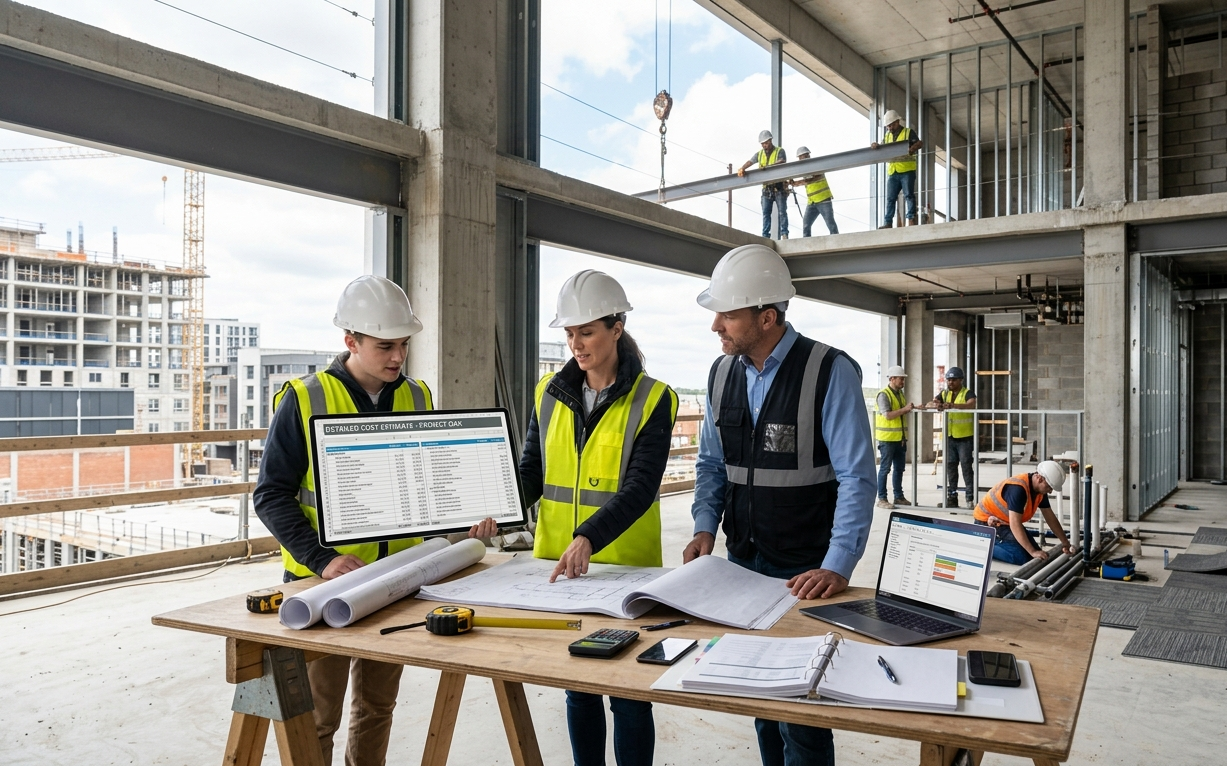
Every successful construction project starts long before the first shovel hits the ground. It starts with a number, an accurate, defensible number that tells you what the job will really cost. That’s exactly what reliable Construction Cost Estimation Services deliver: a clear financial roadmap that helps contractors, developers, and project owners bid smarter, plan better, and avoid costly surprises down the line.
In an industry where material prices shift weekly, and labor costs vary by region, guessing simply isn’t an option anymore. Whether you’re a general contractor bidding on a commercial build or a subcontractor pricing out a specialty scope, professional estimating support has become the backbone of profitable project delivery.
Why Construction Cost Estimation Services Matter More Than Ever
Construction costs are volatile. Steel, lumber, and finishing materials fluctuate based on supply chains, tariffs, and demand, and even a small miscalculation can turn a profitable bid into a financial loss. This is where dedicated estimating support makes the difference between guessing and knowing.
A well-prepared estimate does more than list numbers. It breaks down:
- Material quantities and current market pricing
- Labor hours by trade
- Equipment and overhead costs
- Contingency allowances for risk management
For example, a mid-sized contractor bidding on a 20,000-square-foot retail build-out might assume rough material costs based on past jobs. But without a detailed takeoff and current pricing data, that contractor could underbid by 8–12%, eating directly into profit margins. A professional estimate catches these gaps before the bid goes out, not after the contract is signed.
The Core Building Block: Construction Takeoff Services
Every accurate estimate begins with a precise takeoff, the process of measuring quantities directly from architectural and engineering drawings. Construction Takeoff Services identify exact material quantities for concrete, framing, doors, windows, and finishes, eliminating the guesswork that leads to over-ordering or costly shortages mid-project.
Digital takeoff tools now allow estimators to measure directly from PDF or CAD drawings with far greater accuracy than manual methods, cutting estimation time while improving precision. This is the foundation that everything else-pricing, scheduling, and bidding-is built on.
How Construction Cost Estimating Supports Smarter Bidding
Construction Cost Estimating goes beyond takeoffs by applying real-time pricing, labor productivity rates, and regional cost data to produce a bid-ready number. This is where strategy meets math.
A trustworthy estimating partner will typically:
- Review project drawings and specifications in detail
- Perform a full quantity takeoff by trade
- Apply current material and labor pricing
- Build in appropriate overhead, profit, and contingency
- Deliver a transparent, line-item breakdown
This transparency matters. Contractors who understand exactly where every dollar in their bid comes from are better positioned to negotiate with suppliers, defend their pricing to owners, and win work without sacrificing margin.
Specialty Estimating: Where Detail Wins Bids
General estimates work for early budgeting, but competitive bids demand trade-specific precision. This is where specialty estimating services add real value:
Flooring Estimating Services calculate exact material needs for tile, carpet, vinyl, and hardwood installations, accounting for waste factors and pattern layouts that generic estimates often miss.
Metals Takeoffs & Estimating covers structural steel, rebar, and miscellaneous metals, trades where pricing errors can significantly impact a project’s bottom line due to high material costs.
Masonry Estimating Services account for brick, block, and stone quantities along with mortar and labor productivity, which vary widely depending on wall complexity and coursing patterns.
Plumbing Estimating Services break down piping, fixtures, and rough-in labor by system, helping mechanical contractors bid with confidence on both new construction and renovation work.
Each of these trades has its own pricing logic, waste factors, and labor productivity benchmarks. A generic, one-size-fits-all estimate simply can’t capture that level of nuance, but specialty estimators who work in these trades daily can.
Beyond Estimating: Shop Drawings and Engineering Review
Accurate numbers are only part of the picture. Projects also need documentation that translates design intent into buildable instructions.
Shop Drawing Services convert architectural and engineering plans into detailed fabrication and installation drawings for trades like steel, millwork, and precast concrete, reducing field errors and rework.
PE Review & Stamping Services provide licensed professional engineer verification for structural and design elements that require regulatory approval, ensuring drawings meet local building codes before submission. This step is often required for permitting and adds a critical layer of accountability to the design process.
Together, these services bridge the gap between estimating and execution, keeping projects compliant, coordinated, and ready to build.
Practical Example: How It All Comes Together
Consider a contractor bidding on a 50-unit multifamily residential project. Instead of relying on rough per-square-foot averages, they bring in specialty support: a detailed takeoff for framing and finishes, trade-specific pricing for flooring and plumbing, masonry estimating for the exterior facade, and a shop drawing package for structural steel connections, later verified through PE review.
The result? A bid that’s not only competitive but defensible, one that accounts for real material costs, real labor productivity, and real code requirements. That level of detail is often the difference between winning the job and losing it to a competitor with a tighter, better-supported number.
According to industry data from the Associated General Contractors of America, material and labor cost volatility remains one of the top risk factors contractors cite when pricing projects , reinforcing why detailed, current estimating data is no longer optional.
Electing the Right Estimating Partner
Not all estimating services are created equal. Look for a partner who offers:
- Trade-specific expertise across multiple scopes
- Transparent, itemized breakdowns rather than lump-sum guesses
- Fast turnaround times that fit competitive bidding deadlines
- Consistent accuracy backed by real project experience
The right partner doesn’t just hand you numbers; they help you understand the reasoning behind them, so you can bid with confidence and build with clarity.
Final Thoughts
Better construction decisions really do begin with better numbers. From initial takeoffs to trade-specific pricing, shop drawings, and engineering review, every stage of the estimating process plays a role in protecting your margins and your reputation. Investing in professional, detailed estimating support isn’t an added expense; it’s a safeguard against the far greater cost of an inaccurate bid.
FAQs
1. What are Construction Cost Estimation Services, and why do I need them?
Construction Cost Estimation Services provide detailed, accurate cost breakdowns for a project’s materials, labor, and equipment before construction begins. They help contractors bid competitively while protecting profit margins from pricing errors.
2. How is Construction Cost Estimating different from a rough budget?
A rough budget uses general per-square-foot averages, while Construction Cost Estimating uses detailed takeoffs, current material pricing, and trade-specific labor rates to produce a precise, defensible number.
3. Do I need separate estimates for specialty trades like flooring or masonry?
Yes. Flooring Estimating Services, Masonry Estimating Services, and similar trade-specific estimates account for material waste, labor productivity, and installation complexity that general estimates typically overlook.
4. What’s the difference between Construction Takeoff Services and full cost estimating?
Construction Takeoff Services measure exact material quantities from drawings, while full cost estimating applies pricing, labor, and overhead to those quantities to produce a complete bid.
5. Why would a project need PE Review & Stamping Services?
PE Review & Stamping Services provide licensed engineer verification for structural and design elements, which is often required for permitting and ensures drawings meet local building codes before construction starts.